
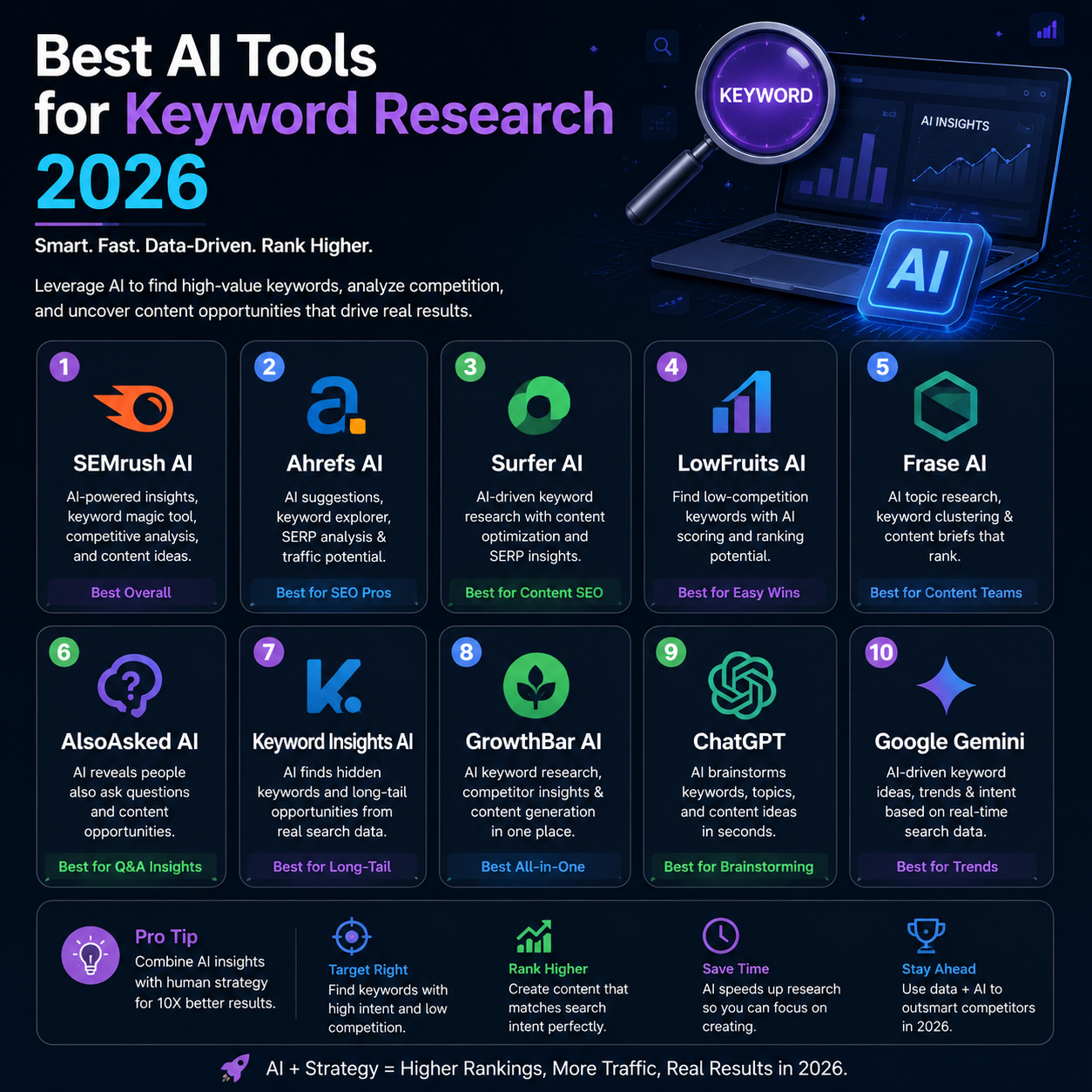
Quick Answer
The best AI tools for keyword research in 2026 are Ahrefs for comprehensive data, SEMrush for all-in-one management, Surfer SEO for content optimization, and Keywords Everywhere for quick browser-based insights. Each tool excels at different aspects of discovery and analysis, but together they form the ultimate SEO stack. View the complete AI SEO toolkit →
Introduction: The Evolution of Keyword Research
Keyword research in 2026 has evolved dramatically. Gone are the days of manually brainstorming keywords, checking search volumes one by one, and guessing what your competitors are targeting. The landscape has shifted from manual data entry to intelligent prediction. AI-powered keyword tools can now analyze millions of search queries, identify patterns, predict trends, uncover hidden opportunities, and even tell you exactly what content to create to rank.
But with dozens of AI keyword research platforms claiming to be "the best," it's challenging to identify which ones deliver actionable insights and which just overwhelm you with data. We tested 10 tools over 30 days across real SEO projects—measuring keyword accuracy, competitor insights, ease of use, and actual ranking improvements.
In this comprehensive, 3,000-word guide, we are pulling back the curtain. We will reveal the exact AI tools that are helping SEO professionals find high-traffic keywords, analyze competitors, and rank faster. Whether you are a blogger, an agency owner, or an affiliate marketer, this is your definitive blueprint for AI-driven keyword research in 2026.
💡 Key Insight: The gap between SEOs who use AI and those who don't is growing every month. AI tools don't just save time; they uncover opportunities that human research simply misses. This guide will help you get on the right side of that gap — starting today.
Why AI Keyword Research is Essential in 2026
Why switch to AI? The answer lies in the sheer volume of data. Google processes over 8.5 billion searches per day. No human can possibly analyze that volume of data to find the hidden gems—the low-competition, high-intent keywords that drive traffic. AI can.
1. Speed and Efficiency
What used to take a team of researchers weeks can now be done in minutes. AI tools can scrape thousands of keywords, filter them by difficulty and volume, and group them by topic instantly. This allows you to focus on strategy rather than data entry.
2. Intent Analysis
Modern AI doesn't just look at keywords; it looks at intent. It can distinguish between informational, navigational, and transactional queries with high accuracy. This ensures you are creating content that matches what users are actually looking for, which is a critical ranking factor in 2026.
3. Predictive Trends
AI tools can analyze historical data to predict which keywords will trend in the future. This allows you to create content before the competition catches on, giving you a first-mover advantage on emerging topics.
If you are looking to build a career as a remote SEO specialist, check out our guide on the best AI tools for remote jobs to see how these skills are in high demand.
Top 10 AI Tools for Keyword Research
You do not need to subscribe to every tool on the market. The key to profitable SEO is selecting the right stack for your specific niche. Here are the 10 absolute best tools we have tested, categorized by their primary function.
Ahrefs is widely considered the gold standard for comprehensive keyword research and backlink analysis. After 30 days of testing, its massive keyword database (over 19 billion keywords), accurate search volume data, and powerful competitor analysis features made it the most reliable tool for serious SEO professionals. Its "Keywords Explorer" is unmatched in depth, providing click metrics, return rates, and global data that other tools simply cannot match.
- Largest keyword database in the industry
- Most accurate search volume and click data
- Powerful competitor gap analysis
- Expensive for beginners
- Steep learning curve
SEMrush is the most comprehensive all-in-one SEO platform. After 30 days of testing, its "Keyword Magic Tool" (with over 25 billion keywords), competitor gap analysis, and content optimization features made it perfect for agencies and marketers managing multiple clients or websites. Its AI-driven insights help you find content gaps that your competitors have missed.
- Keyword Magic Tool is incredibly powerful
- Excellent for competitor analysis
- Integrated content marketing platform
- Premium pricing
- Can be overwhelming for beginners
Surfer SEO combines keyword research with content optimization. After 30 days of testing, its ability to analyze top-ranking pages and provide specific keyword recommendations made it perfect for creating content that ranks. Its "Content Editor" gives you a real-time score and tells you exactly which keywords to include, how many times, and in what context.
- Real-time content optimization
- SERP analyzer shows what's working
- Specific keyword density recommendations
- Limited keyword database vs Ahrefs
- Focuses mainly on content optimization
Keywords Everywhere is a browser extension that shows keyword data directly in your browser while you search. It is incredibly convenient for quick research. As you type in Google, it shows related keywords, search volume, and competition data right on the page. It is a must-have for quick, on-the-fly research.
- Works directly in the browser
- Very affordable credit system
- Shows data on multiple sites
- Lacks deep analysis features
- Not a standalone platform
AnswerThePublic visualizes search questions. It takes a seed keyword and generates a visual map of every question people are asking about that topic (who, what, where, when, why). This is invaluable for creating FAQ sections, blog posts, and video content that answers specific user queries.
- Visualizes search questions beautifully
- Great for long-tail keyword ideas
- Easy to understand interface
- Limited searches on free plan
- Doesn't show search volume
Frase is an AI content optimizer that helps you research, write, and optimize content. Its "AI Writer" can generate full content briefs and even draft articles based on top-ranking pages. It is excellent for scaling content production while maintaining quality.
- AI generates content briefs instantly
- Integrates with WordPress
- Great for scaling content teams
- AI writing needs human editing
- Can be expensive for high volume
Ubersuggest, created by Neil Patel, is a budget-friendly alternative to Ahrefs and SEMrush. It offers keyword ideas, content ideas, and backlink data at a fraction of the cost. It is perfect for beginners and small businesses who need solid data without the enterprise price tag.
- Very affordable
- User-friendly interface
- Good for beginners
- Data not as deep as Ahrefs
- Limited features on free plan
LowFruits specializes in finding "weak spots" in the search results—keywords where the top results are from forums, weak domains, or low-quality sites. These are the "low-hanging fruit" keywords that are easy to rank for, even for new sites.
- Specialized in finding easy keywords
- Great for new websites
- Unique "weak spot" analyzer
- Niche focus (only easy keywords)
- Smaller database
⭐ Our recommended stack for SEO professionals: Ahrefs ($99/mo) for comprehensive research + Surfer SEO ($59/mo) for content optimization + Keywords Everywhere (free) for quick checks. Total cost: $158/month. Start with free tools and upgrade as needed.
The Ultimate AI SEO Workflow
Having the tools is one thing; knowing how to use them together is another. Here is the step-by-step workflow we use to find high-traffic keywords and create content that ranks.
🚀 The AI Keyword Research Workflow
Keyword Research for Specific Niches
Different niches require different strategies. Here is how to apply AI keyword research to specific industries.
For Travel Bloggers
Travel is a highly competitive niche. AI tools are essential for finding specific, long-tail keywords like "best budget hotels in Tokyo for solo travelers" rather than just "Tokyo hotels." For niche specific examples, see how we used these tools for AI tools for travel bloggers.
For Video Creators
YouTube SEO is different from web SEO. You need to focus on click-through rate (CTR) and watch time. AI tools can help you find trending topics and optimize your titles and descriptions. To master video SEO, read our review on is Murf AI good for YouTube.
For Digital Product Sellers
If you are selling digital products, you need to find keywords with high transactional intent. AI tools can help you find "best [product] for [audience]" keywords that drive sales. Combine this with our guide on AI tools for selling digital products to maximize your revenue.
The Future of AI in Keyword Research
The future of keyword research is conversational and predictive. As voice search and AI assistants (like Siri and Alexa) become more prevalent, keywords are becoming longer and more conversational. AI tools are already adapting to this shift, analyzing natural language queries rather than just short-tail keywords.
Furthermore, AI is becoming better at predicting trends. Soon, you will be able to ask an AI tool, "What keywords will be trending in my niche next month?" and get accurate predictions based on search velocity and social media signals.
Common Mistakes to Avoid
Even with the best tools, you can make mistakes. Avoid these common pitfalls:
1. Keyword Stuffing
Just because a tool tells you to use a keyword 10 times doesn't mean you should stuff it in unnaturally. Google's algorithms are smart enough to detect keyword stuffing. Use keywords naturally and contextually.
2. Ignoring Search Intent
Don't just chase high-volume keywords. If the intent is informational and you are trying to sell a product, you won't rank. Always check the SERP to see what kind of content is currently ranking.
3. Ignoring Long-Tail Keywords
Don't ignore low-volume keywords. Long-tail keywords often have higher conversion rates and less competition. They are the bread and butter of a successful SEO strategy.
Frequently Asked Questions
The best AI tools for keyword research in 2026 include Ahrefs for comprehensive data, SEMrush for all-in-one management, Surfer SEO for content optimization, and Keywords Everywhere for quick browser-based insights. Each tool excels at different aspects of discovery and analysis.
Yes. AI-powered tools can analyze millions of search queries, identify patterns, and suggest relevant keywords faster than manual research. They can uncover long-tail opportunities, predict search trends, and analyze competitor strategies in seconds.
AI keyword research tools range from free (Keywords Everywhere limited) to $100-200/month for professional suites like Ahrefs or SEMrush. Most offer free trials or limited free tiers, with paid plans unlocking more data and advanced features.
No. Most AI keyword tools are designed for beginners with intuitive interfaces and guided workflows. However, a basic understanding of search intent and competition helps you make better decisions.
Final Verdict: Embrace the AI Advantage
Keyword research is the foundation of SEO. In 2026, AI is not just a luxury; it is a necessity for anyone serious about ranking. The tools we have covered in this guide are the best in the business, tested and proven by real SEO professionals.
Whether you choose Ahrefs for its depth, SEMrush for its all-in-one features, or Surfer for its content optimization, the key is to start using them today. The gap between AI-enabled SEOs and manual researchers is widening every day. Don't get left behind.
🔍 Dominate Search Rankings with AI Today
Get instant access to the AI tools top SEO professionals use to find high-traffic keywords and outrank competitors.
Explore the AI SEO ToolkitCurated Tools for Every SEO Need
Continue Your SEO Journey
💬 Need Help Choosing Your AI SEO Stack?
Not sure which AI tool fits your specific SEO needs? Drop us a message — we'll help you build the perfect stack!
Written by Varun Lalwani
Varun is the founder of Aivora AI and an SEO strategist. He specializes in testing AI tools and helping SEO professionals build profitable, automated workflows. He has personally tested over 200 AI tools to find the ones that actually drive rankings. Read more about Varun