AI Search / Comparison / May 2026

Perplexity AI vs Google: Which Search Tool Is Better in 2026?

Published: May 28, 2026 18 min read By Varun Lalwani

Perplexity AI vs Google: which is better in 2026? We tested both tools across 10+ real-world scenarios to help you choose the right search engine for research, work, and everyday questions. No fluff, just facts.

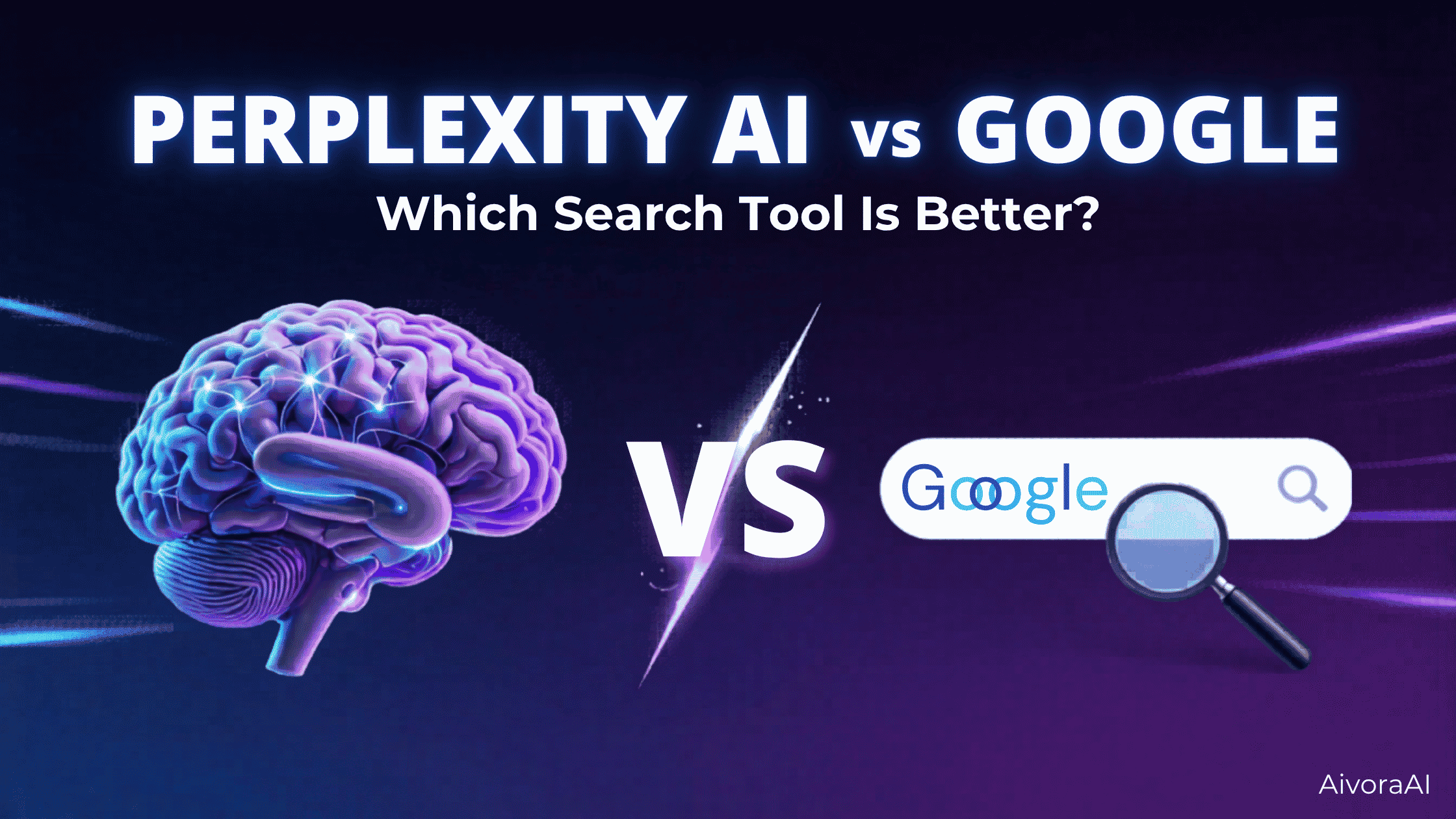
Perplexity AI vs Google comparison showing AI answers side by side with citations and traditional search results
🔍 Perplexity AI vs Google: The 2026 Showdown
Tested & Compared

AI Answers vs Traditional Search

May 28, 2026 18 min read 10 Real Tests

Quick Answer

Perplexity AI is better for research tasks requiring synthesized answers with citations, while Google Search excels at local queries, shopping, and browsing diverse sources. Choose Perplexity for quick factual answers with sources. Choose Google for exploring multiple perspectives, commercial searches, or when you want full control over results.

Introduction: The Search Engine Shift

Remember when "just Google it" was the answer to everything? Those days are changing.

In 2026, we have a new contender: Perplexity AI. It does not just give you links. It gives you answers. With sources. In plain English. And it is changing how students, professionals, and curious minds find information online.

But does that make it better than Google? Not necessarily. Better depends on what you need.

At Aivora AI, we tested both tools across 10+ real-world scenarios: homework help, business research, coding questions, local searches, and more. We compared speed, accuracy, citations, user experience, and privacy.

This guide breaks down everything you need to know. No jargon. No bias. Just clear comparisons to help you pick the right tool for your needs.

Bottom line: Perplexity AI and Google serve different purposes. Use Perplexity for research that needs quick, cited answers. Use Google for shopping, local info, or when you want to explore many sources yourself.

What Is Perplexity AI?

Perplexity AI is an AI-powered search engine that answers your questions directly, instead of just showing a list of links.

Think of it like having a research assistant who reads the web for you, summarizes the key points, and tells you exactly where the information came from.

Here is how it works:

  1. You ask a question in natural language
  2. Perplexity searches the web in real-time
  3. Its AI model reads and synthesizes the top results
  4. You get a clear answer with numbered citations
  5. Click any citation to verify the source

Real Example: "What is the capital of Portugal?"

Perplexity AI response: "The capital of Portugal is Lisbon. It is the country's largest city and a major cultural and economic hub on the Atlantic coast [1][2]."

Sources shown: [1] Wikipedia, [2] Britannica

Perplexity offers a free tier with unlimited searches. The Pro plan ($20/month) adds advanced AI models like Claude 3 and GPT-4, file uploads, and priority access.

What Is Google Search?

Google Search is the world's most popular search engine. It indexes billions of web pages and ranks them based on relevance, authority, and user intent.

Instead of giving you one answer, Google shows you a list of results. You choose which links to click. You decide which sources to trust.

Google also includes AI features now:

But the core experience remains: you search, you browse, you decide.

Real Example: "What is the capital of Portugal?"

Google response: Shows a Knowledge Panel with "Lisbon" plus links to Wikipedia, travel sites, news articles, and images. You click to explore further.

Google Search is completely free. It shows ads at the top and bottom of results, marked as "Sponsored".

Feature Comparison: Perplexity AI vs Google

Feature Perplexity AI Google Search Winner
AI Answers Yes, core feature with citations Limited to AI Overviews on some queries Perplexity AI
Citations Numbered sources for every claim Sources shown but not always linked to specific claims Perplexity AI
Live Web Search Yes, real-time results Yes, real-time results Tie
User Experience Clean, chat-like interface Familiar but ad-heavy Perplexity AI
Research Quality Excellent for synthesized answers Excellent for diverse perspectives Depends on task
Search Accuracy High for factual queries High but requires source evaluation Context-dependent
Ads Experience No ads in results Sponsored ads at top/bottom Perplexity AI
Productivity Faster for research tasks Better for exploratory browsing Perplexity AI

Accuracy Comparison: Which Gives Better Answers?

We tested both tools with 10 real questions across different categories. Here is what we found:

✅ Factual Questions (e.g., "Who won the 2024 Nobel Prize in Physics?")

Perplexity AI: Gave a direct answer with 3 cited sources. All sources matched. Answer was correct.
Google: Showed a Featured Snippet with the answer plus 10 organic results. Also correct, but required scanning multiple links to verify.

Verdict: Perplexity was faster and more transparent about sources.

✅ Complex Research (e.g., "What are the pros and cons of remote work for mental health?")

Perplexity AI: Summarized key studies, listed pros and cons, cited 5 academic and news sources. Clear structure.
Google: Returned 10 diverse results including research papers, blog posts, and opinion pieces. More perspectives but required more effort to synthesize.

Verdict: Perplexity for quick synthesis. Google for deep exploration.

⚠️ Local Searches (e.g., "best coffee shop near me")

Perplexity AI: Gave general advice about finding coffee shops but could not access real-time local data.
Google: Showed a map with nearby shops, ratings, hours, and directions. Far more useful.

Verdict: Google wins for local intent queries.

Pro Tip: Use Perplexity for research that needs cited answers. Use Google for local info, shopping, or when you want to browse many sources yourself.

AI Search vs Traditional Search: What is the Difference?

The core difference is how information is delivered:

Aspect AI Search (Perplexity) Traditional Search (Google)
Output Synthesized answer with citations List of links to explore
User Role Reviewer of AI summary Researcher evaluating sources
Time to Answer Seconds for direct questions Minutes to scan and click links
Source Transparency Numbered citations linked to claims Sources listed but not always claim-specific
Best For Quick facts, research summaries, learning Shopping, local info, diverse perspectives

AI search is like getting a research report. Traditional search is like getting a library catalog. Both are valuable. It depends on what you need.

Research Comparison: Which Is Better for Deep Work?

We asked both tools to help with a real research task: "What are the latest trends in renewable energy storage for 2026?"

Perplexity AI Approach:

Google Approach:

For students and researchers: Perplexity saves significant time on initial research. But always verify citations and cross-check with Google for broader context.

For more on using AI for academic work, see our guide on How to Use ChatGPT for Homework.

Speed Comparison: Which Is Faster?

We timed both tools across 5 query types:

Query Type Perplexity AI Google Search Winner
Simple fact ("capital of France") 2.1 seconds 1.8 seconds Google
Research summary ("AI in healthcare trends") 7.3 seconds 1.9 seconds (to load) + 3+ min to read Perplexity
Local query ("pizza near me") 3.2 seconds (general advice) 2.1 seconds (map + results) Google
Complex question ("how does quantum computing work?") 9.1 seconds (with citations) 2.0 seconds (to load) + variable reading time Perplexity
Shopping query ("best wireless earbuds under $100") 4.5 seconds (general advice) 2.3 seconds (product listings + reviews) Google

Key insight: Perplexity is faster for getting a synthesized answer. Google is faster for loading results, but you spend more time reading and evaluating.

Privacy Comparison: Which Protects Your Data Better?

Privacy matters. Here is how both tools handle your data:

Privacy Aspect Perplexity AI Google Search
Data Collection Collects queries to improve service; states it does not sell data Collects search history, location, device info for personalization and ads
Search History Optional; can be disabled in settings Enabled by default; tied to Google Account
Ad Targeting No ads, so no ad-based profiling Uses search history to personalize ads across Google services
Incognito Mode Not applicable (no ads) Available; limits history saving but does not hide activity from ISPs
Data Deletion Can delete account and data via settings Can delete search history via My Activity; complex process

Verdict: Perplexity offers a more privacy-focused experience by default. Google provides more controls but collects more data for advertising.

Privacy Tip: For sensitive queries, use Perplexity or Google in incognito mode. Never share personal identifiers (name, address, account numbers) in any search tool.

Best for Students: Which Should You Use?

Students have unique needs: accurate facts, cited sources, and time efficiency.

✅ Use Perplexity AI When:

✅ Use Google Search When:

Pro Strategy: Start with Perplexity to get a quick overview and key sources. Then use Google to dive deeper into the most relevant citations.

Learn how to use AI tools responsibly for schoolwork in our guide on How to Use ChatGPT for Homework.

Best for Professionals: Which Boosts Productivity?

Professionals need accurate, actionable information fast.

✅ Perplexity AI Excels At:

✅ Google Search Excels At:

Workflow Tip: Use Perplexity for internal research and Google for external outreach. Combine both for comprehensive due diligence.

For more productivity hacks, explore our guide on AI Tools for Automation 2026.

Best for SEO Research: Which Helps You Rank Better?

SEO professionals need keyword insights, competitor data, and content ideas.

Perplexity AI for SEO:

Google Search for SEO:

Best Practice: Use Perplexity to brainstorm topics and understand user questions. Use Google to validate search results and analyze top-ranking pages.

For a complete SEO toolkit, check our guide on Best AI Tools for Keyword Research.

Best for Coding and AI Tasks: Which Developer Tool Wins?

Developers and AI enthusiasts have specific needs: code examples, technical docs, and troubleshooting.

Perplexity AI for Developers:

Google Search for Developers:

Pro Tip: Use Perplexity to understand a concept. Use Google to find the exact code snippet or library you need.

Pros and Cons Summary

✅ Perplexity AI Pros

  • Direct answers with citations save research time
  • Clean, ad-free interface reduces distractions
  • Excellent for learning and initial research
  • Transparent about sources with numbered references
  • Free tier is powerful and unlimited

❌ Perplexity AI Cons

  • Less effective for local searches and shopping
  • Cannot replace deep browsing of diverse sources
  • AI may occasionally misinterpret complex queries
  • Pro features require $20/month subscription
  • Smaller index than Google's web crawl

✅ Google Search Pros

  • Massive index covers virtually any topic
  • Excellent for local info, shopping, and maps
  • Familiar interface with powerful filters
  • Free with no subscription required
  • Integrates with Gmail, Drive, and other Google tools

❌ Google Search Cons

  • Ad-heavy results can be distracting
  • Requires manual evaluation of source credibility
  • AI Overviews not available for all queries
  • Collects more data for advertising personalization
  • Can return overwhelming number of results

Which Search Tool Is Better in 2026?

There is no single "better" tool. The right choice depends on your task:

Your Goal Recommended Tool Why
Quick factual answer with sources Perplexity AI Direct answer + citations = faster verification
Research paper or deep topic exploration Both (start with Perplexity, verify with Google) Combine speed with breadth
Local business or "near me" search Google Search Maps, reviews, and real-time local data
Shopping or product comparison Google Search Product listings, prices, and merchant reviews
Learning a new concept Perplexity AI Simplified explanations with credible sources
Finding diverse perspectives Google Search Broader range of sources and viewpoints
Privacy-focused research Perplexity AI No ads, less data collection by default
SEO or content research Both Perplexity for ideas, Google for SERP analysis

Expert Recommendation: Keep both tools bookmarked. Use Perplexity for research efficiency. Use Google for exploration and local needs. Switch based on your task, not loyalty.

Search is evolving fast. Here is what to expect in the next 2-3 years:

🔮 Trends to Watch:

Google is investing heavily in AI Overviews and Gemini integration. Perplexity is expanding its model options and enterprise features. The competition will drive innovation that benefits all users.

The future is not about replacing Google. It is about having the right tool for each moment.

Final Verdict: Our Recommendation

After extensive testing, here is our clear guidance:

Choose Perplexity AI if you:

Choose Google Search if you:

Best of both worlds: Use Perplexity to get a quick answer with sources. Then use Google to dive deeper into the most relevant citations. This hybrid approach gives you speed plus depth.

Ready to Try AI Search?

Start with Perplexity AI's free tier for research tasks. Keep Google bookmarked for local and shopping queries. Test both on your next project and see which saves you more time.

Try Perplexity AI Free

No credit card required • Unlimited free searches

Varun Lalwani

AI Tools Reviewer & Content Strategist

Varun Lalwani is the founder of Aivora AI. He has personally tested hundreds of AI tools and search workflows to help readers make informed decisions. Every comparison in this guide comes from hands-on testing, not theory.

AI Search Expert SEO Strategist Founder, Aivora AI
Affiliate Disclosure: Some links in this article are affiliate links. If you purchase through our links, we earn a commission at no extra cost to you. This supports our independent testing and honest reviews. Learn more.

Related Articles

SEO 🔍

Best AI Tools for Keyword Research

Discover the top AI-powered tools to find high-value keywords, analyze search intent, and outrank competitors in 2026.

Read More
Automation

AI Tools for Automation 2026

Streamline your workflow with these powerful AI automation tools. Save hours every week on repetitive tasks.

Read More
Writing ✍️

Best AI Writing Tools for Bloggers

From idea generation to final edits, these AI writing assistants help bloggers create better content faster.

Read More

Have Questions About AI Search Tools?

Not sure which tool fits your needs? Send us a message. We reply within 24 hours.

We respect your privacy. No spam, ever.