Quick Answer
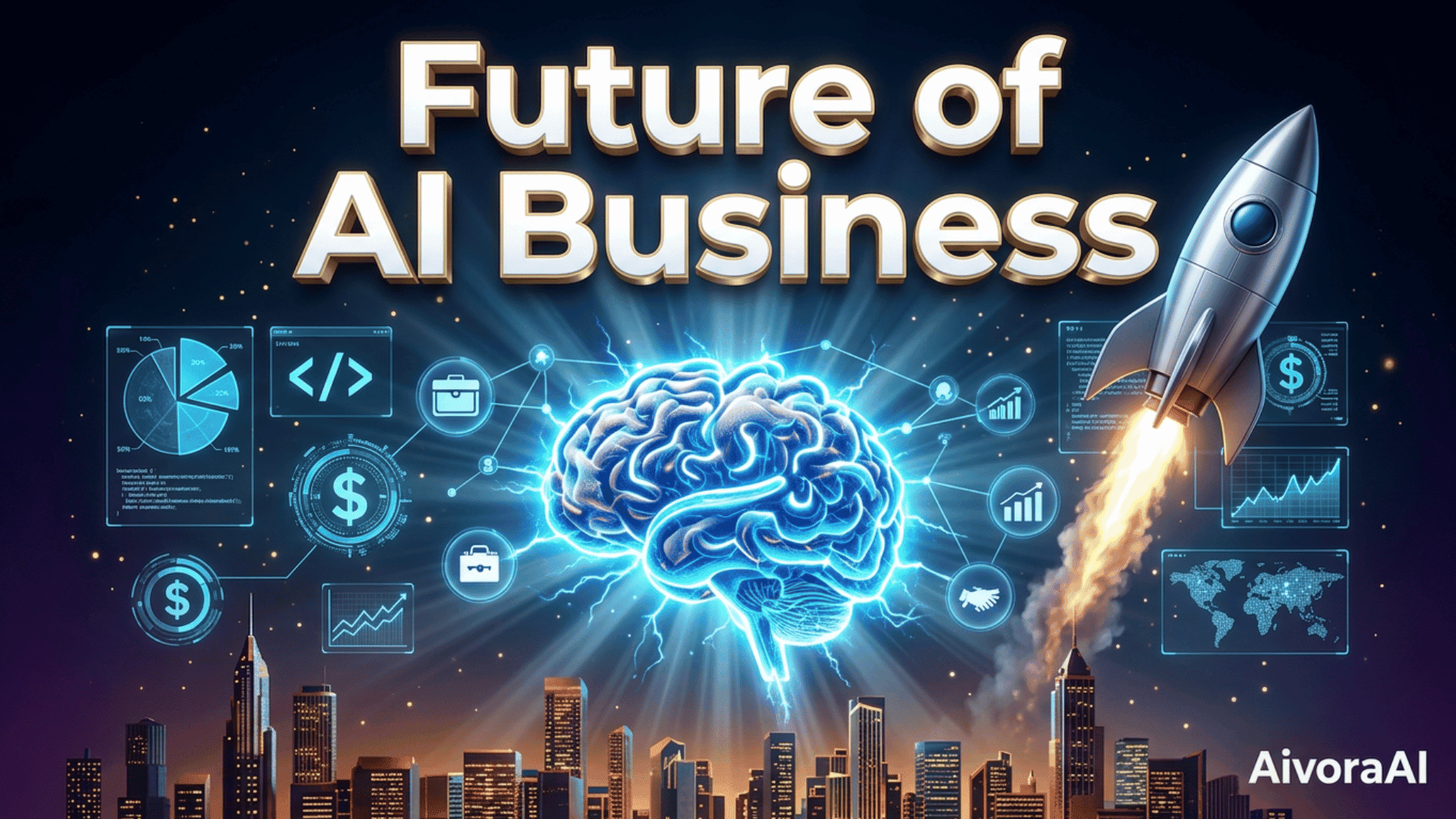
The future of AI business (2026-2030) is defined by "AI-Native" operations. We are moving from AI as a tool to AI as the core infrastructure. Key trends include autonomous business agents, hyper-personalization at scale, and outcome-based pricing models. By 2030, companies won't just "use" AI; they will be built entirely around it, creating new categories of value and efficiency that were previously impossible.
We're standing at a pivotal moment in business history. Artificial intelligence has moved from experimental technology to core business infrastructure. But what we're seeing today is just the beginning.
By 2030, AI will fundamentally reshape how businesses operate, compete, and create value. The companies that thrive won't just use AI—they'll be built on AI-native principles from the ground up.
This isn't about predicting the future—it's about preparing for it. Whether you're an entrepreneur, executive, or aspiring founder, understanding where AI business is heading is critical to making smart decisions today.
If you are looking to leverage these trends for personal career growth, tools like FreeResume.Pro AI Resume Builder are already using these technologies to help professionals land roles in this new economy.
🚀 The Evolution of AI in Business
🛠️ AI as Tool
Copilots, Chatbots, Basic Automation
🔗 AI Integration
Workflow Automation, Agents, Data Insights
🧠 AI-Native
Autonomous Ops, Predictive Strategy
🌐 AI Ecosystem
Self-Healing Biz, Synthetic Data, BCI
Why Understanding the Future Matters Now
The pace of AI advancement is accelerating exponentially. The "wait and see" approach is now a high-risk strategy.
Key Statistics:
- Market Growth: Global AI market projected to reach $1.8T by 2030 (up from $200B in 2023).
- Adoption Rate: 83% of companies now prioritize AI in business strategy.
- Productivity Impact: AI could add $13T to global GDP by 2030.
💡 Insight: Early adopters gain significant market share. Understanding these trends helps you avoid costly missteps and spot emerging niches before they become crowded.
8 Key Trends Shaping the Future (2026-2030)
1. AI-Native Business Models
Businesses built from the ground up with AI as core infrastructure. These companies achieve 5-10x efficiency gains. Think of autonomous e-commerce stores that optimize pricing and inventory in real-time without human intervention.
2. Hyper-Personalization at Scale
AI enabling truly individualized experiences for millions. If you are in content creation, using AI video creator tools allows you to generate personalized video messages for thousands of leads instantly.
3. Autonomous Business Operations
AI systems that make and execute decisions with minimal human intervention. From supply chain rerouting to automated financial auditing, the "human in the loop" becomes the "human on the loop."
4. Outcome-Based Pricing
The shift from selling "software" to selling "results." Instead of paying for a marketing tool, you pay for the leads generated. This aligns incentives perfectly between vendor and client.
5. The Rise of Vertical AI Agents
Generic AI is out; specialized AI is in. We will see AI agents specifically trained for dentistry, logistics, or law. These agents will understand industry jargon and regulations better than any general model.
6. AI-Powered Sustainability
"Green AI" will become a competitive differentiator. AI optimizing energy grids, reducing manufacturing waste, and optimizing logistics routes to lower carbon footprints.
7. Synthetic Data & Simulation
With privacy laws tightening, businesses will use AI to generate "synthetic" data that mimics real customer behavior without violating privacy. This allows for rigorous testing and training without the legal risk.
8. Decentralized AI Marketplaces
A future where you can rent "intelligence" like you rent cloud storage. Need a model that detects defects in steel pipes? You rent that specific model for an hour, use it, and return it.
Intelligence Layer
Core AI models, LLMs, and predictive engines powering decision making.
Automation Layer
Agents and workflows executing tasks across your entire tech stack.
Data Layer
Synthetic data, real-time streams, and privacy-preserving analytics.
Industry-Specific Transformations
🏥 Healthcare & Life Sciences
AI reducing drug discovery time from 10 years to 2-3 years. Personalized medicine based on individual genetics will become the standard, not a luxury.
🏦 Finance & Insurance
Real-time fraud detection and algorithmic underwriting. We will see "invisible insurance" that automatically covers you based on context (e.g., travel insurance activating the moment you book a flight).
🛒 Retail & E-commerce
Visual search will replace text search. You will snap a photo of a stranger's outfit, and AI will find the exact items or cheaper alternatives instantly. For store owners, using AI tools for website SEO audits will be crucial to capture this visual search traffic.
🎓 Education & Training
The end of "one-size-fits-all" education. AI tutors will adapt to each student's learning speed and style in real-time, potentially closing the global education gap.
Emerging AI-Powered Business Models
💡 The "Data Network Effect" Moat
The most valuable companies of 2030 will be those where every user makes the product better for everyone else. If you are building a platform, focus on how user data improves your core AI. This creates a defensive moat that competitors cannot easily cross. To build authority in your niche, leveraging AI tools for backlink research can help you dominate search results and attract the users needed to fuel this effect.
🏰 Build Defensible MoatsActionable Strategies to Future-Proof
🎯 Short-Term (Next 12 Months)
- Audit Your Data: AI is only as good as the data it feeds on. Clean your databases now.
- Identify "Low-Hanging Fruit": Find repetitive, rules-based tasks in your business and automate them.
- Upskill Your Team: AI literacy will be as important as computer literacy is today.
🚀 Long-Term (3-5 Years)
- Build for Autonomy: Design systems that can run without you. If you want to explore this further, check out our guide on best passive income ideas with AI to see how autonomous systems can generate revenue.
- Invest in Proprietary Data: Public data is a commodity. Your unique data is your gold mine.
- Ethical AI Governance: Trust will be the currency of the future. Build transparent AI now to avoid regulatory backlash later.
🔮 Ready to Future-Proof Your Business?
Don't get left behind. Explore our curated collection of AI tools and strategies designed for the 2030 economy.
🚀 Explore AI Business Tools →✓ Strategic Frameworks · ✓ Trend Reports · ✓ Tool Reviews
Frequently Asked Questions
By 2030, AI will transition from a supportive tool to the core infrastructure of most businesses. We expect to see 'AI-native' companies where autonomous agents handle operations, hyper-personalization becomes the standard for customer experience, and new business models based on outcome-as-a-service replace traditional subscriptions.
AI will shift business models from product-centric to outcome-centric. Instead of selling software, companies will sell results (e.g., 'pay per lead' instead of 'pay per CRM seat'). We will also see the rise of 'Data Network Effects' where products improve automatically as more users join, creating unbeatable competitive moats.
Key opportunities include vertical-specific AI agents (AI for dentists, AI for logistics), autonomous supply chain management, synthetic data generation for privacy-compliant training, and AI-driven sustainability optimization. The biggest winners will be those who solve specific, expensive industry problems rather than building generic tools.
Related Strategic Guides
💬 Need Help Planning Your AI Strategy?
Not sure how to apply these 2030 trends to your business today? Message us — we'll help you create a roadmap!
Written by Varun Lalwani
Varun is the founder of Aivora AI and a business strategist focused on the intersection of AI and entrepreneurship. He helps businesses navigate the transition to AI-native operations. Read more about Varun