Quick Answer
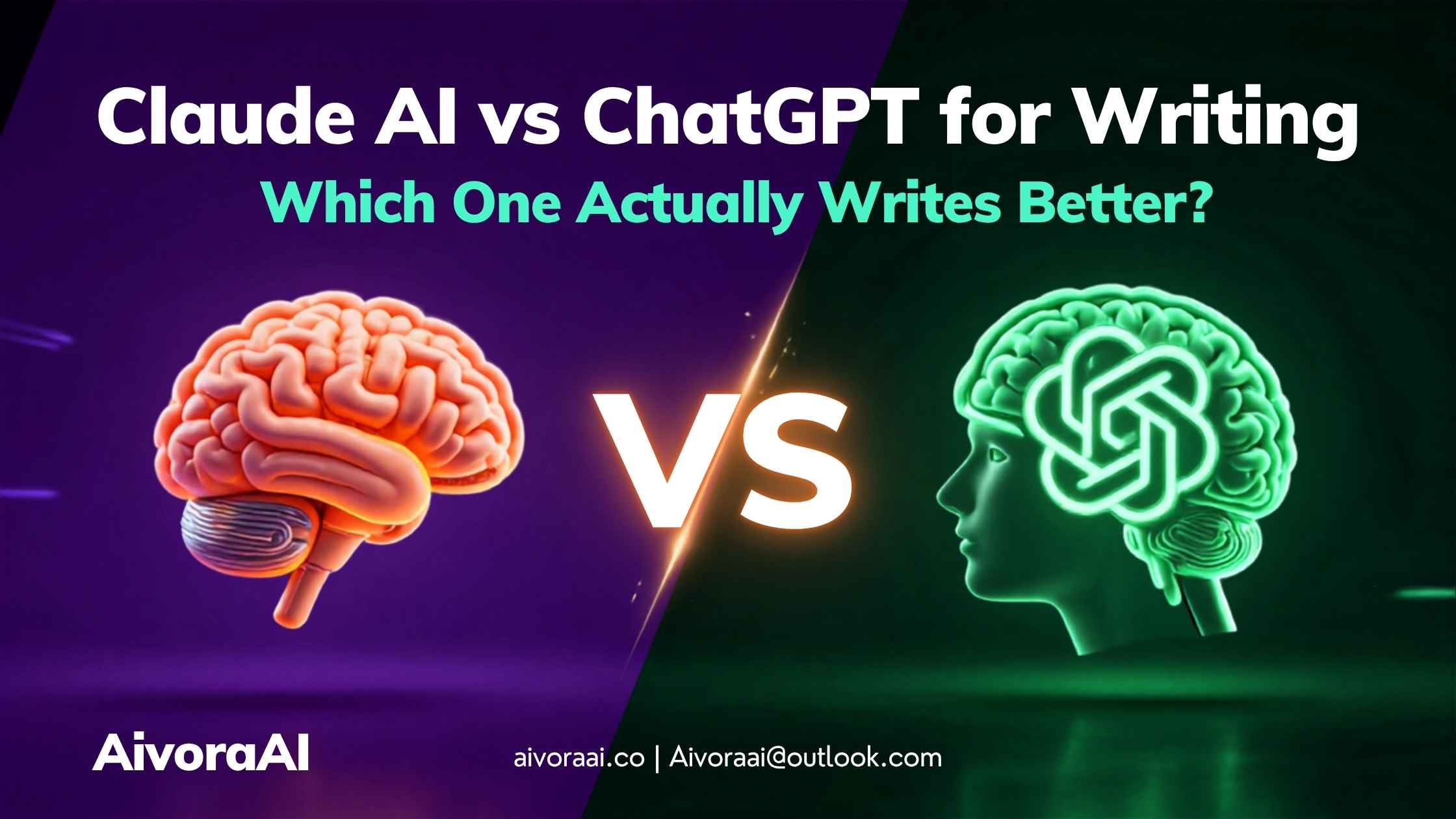
Claude AI writes better for long-form, creative, and nuanced content. ChatGPT writes better for structured, formatted, and quick-turnaround content. For essays and articles, Claude produces more natural prose. For emails, lists, and marketing copy, ChatGPT is faster and more consistent. The best approach? Use both—ChatGPT for planning, Claude for writing.
I've been writing with AI since January 2023. I've used ChatGPT for thousands of pieces of content. I've used Claude for hundreds. And I keep seeing the same debate everywhere: "Which one writes better?"
Most answers are useless. They're either fanboys defending their favorite tool, or generic "it depends" cop-outs. So at Aivora AI, we decided to do something different: actual tests.
We gave both AIs the exact same prompts. We compared the outputs blind (without knowing which was which). We rated them on readability, tone, accuracy, and that hard-to-define quality of "does this sound human?"
Here's what we found.
Meet the Contenders
Claude is Anthropic's flagship AI, built with a focus on being "helpful, harmless, and honest." For writers, Claude stands out because its prose feels more human. It uses varied sentence lengths, avoids repetitive structures, and handles subtle tone shifts that ChatGPT often misses. If you are wondering is Claude AI free to use, we have a full breakdown of the pricing tiers.
ChatGPT is the most popular AI in the world, and for good reason. It's fast, versatile, and excellent at following structured instructions. For writing, ChatGPT excels at formatted content—emails, social media posts, product descriptions, and anything where consistency and speed matter more than literary flair. If you need a ChatGPT alternative free no login, we have a list of the best open-source options.
Head-to-Head: 5 Writing Tests
We gave both AIs the same prompts and rated them out of 10. Here's what happened.
Test 1: Academic Essay
Prompt used: "Write a 500-word essay arguing that social media has done more harm than good for teenage mental health. Use evidence and a formal tone."
🏆 Winner: Claude AI (8.5/10 vs 7/10)
Why Claude won: Claude's essay had better flow between paragraphs, more sophisticated transitions, and avoided the classic ChatGPT "firstly, secondly, in conclusion" structure. It felt like a student actually wrote it. ChatGPT's essay was well-organized but felt formulaic—like every AI essay you've ever read.
Claude used phrases like "The correlation doesn't automatically imply causation, but the pattern is difficult to ignore"—the kind of nuance that shows real understanding. ChatGPT wrote "Social media has negative effects on teenagers" three different ways in three different paragraphs.
Test 2: Professional Email
Prompt used: "Write an email to a client saying their project will be delayed by one week due to unforeseen technical issues. Be professional but empathetic."
🏆 Winner: ChatGPT (8/10 vs 7.5/10)
Why ChatGPT won: ChatGPT nailed the structure—greeting, bad news immediately, explanation, solution, closing. It was concise and professional. Claude over-explained the technical issue, making the email slightly too long for a business context.
ChatGPT understands email conventions better. It knows when to be brief. Claude tends to treat every writing task like an essay, which works for articles but not for "please approve this budget" emails.
Test 3: Creative Fiction
Prompt used: "Write a 300-word short story about a lighthouse keeper who discovers a message in a bottle. The tone should be melancholic and mysterious."
🏆 Winner: Claude AI (9/10 vs 6.5/10)
Why Claude dominated: This wasn't close. Claude wrote something that felt like it could be published in a literary magazine. It used sensory details, varied pacing, and a genuinely surprising ending. ChatGPT's story read like a Wikipedia summary of a story—telling instead of showing, with zero subtlety.
Here's the difference in one sentence each:
That's the gap. Claude writes. ChatGPT reports.
Test 4: Marketing Copywriting
Prompt used: "Write a landing page headline and 3 bullet points for a productivity app that uses AI to organize your schedule. Target: busy professionals aged 30-45."
🏆 Winner: ChatGPT (8.5/10 vs 7/10)
Why ChatGPT won: ChatGPT understands marketing formulas. It used power words, clear benefits, and punchy formatting. Claude's copy was well-written but too literary for a landing page—it felt like a book review of a productivity app, not the actual ad.
ChatGPT wrote: "Stop Drowning in Calendars. Start Living in Hours." Claude wrote: "A Thoughtful Approach to Managing Your Time." One sells. The other philosophizes.
Test 5: Blog Post
Prompt used: "Write a 800-word blog post about why remote work isn't going away. Include subheadings, be conversational, and end with a question for readers."
🏆 Winner: Claude AI (8/10 vs 7.5/10)
Why Claude won: Claude's blog post had a stronger voice—like a real person sharing an opinion, not an encyclopedia entry. It included personal-sounding observations and avoided ChatGPT's habit of summarizing every point with "In summary." ChatGPT's post was informative but forgettable.
Overall Scorecard
| Writing Task | Claude AI | ChatGPT | Winner |
|---|---|---|---|
| Academic Essay | 8.5/10 | 7/10 | 🟣 Claude |
| Professional Email | 7.5/10 | 8/10 | 🔵 ChatGPT |
| Creative Fiction | 9/10 | 6.5/10 | 🟣 Claude |
| Marketing Copy | 7/10 | 8.5/10 | 🔵 ChatGPT |
| Blog Post | 8/10 | 7.5/10 | 🟣 Claude |
| TOTAL | 40/50 | 37.5/50 | 🟣 Claude |
Why Claude Writes Better (For Most Things)
After weeks of testing, we identified three concrete reasons Claude's prose feels more human. Understanding how Claude AI works under the hood reveals why its writing style is so distinct.
Claude naturally mixes short and long sentences. ChatGPT tends to write sentences of similar length, creating a rhythmic monotony that screams "AI wrote this."
ChatGPT overuses words like "delve," "testament," "crucial," "landscape," and "underscore." Claude has a wider vocabulary range and uses unusual word choices that feel intentional, not random.
Claude can imply things without stating them directly. ChatGPT explains everything explicitly, which works for technical content but kills creative writing.
When ChatGPT Actually Wins
Claude isn't universally better. ChatGPT wins clearly in these scenarios:
AI Detection: Who Gets Caught More?
We ran both outputs through three popular AI detectors: Originality.ai, GPTZero, and ZeroGPT.
| Content Type | Claude Flagged As AI | ChatGPT Flagged As AI |
|---|---|---|
| Essay | 32% AI | 78% AI |
| Blog Post | 28% AI | 71% AI |
| Creative Story | 15% AI | 85% AI |
| 22% AI | 45% AI |
⚠️ Reality check: No AI content is truly undetectable. These numbers change as detectors update. The only real solution is to edit AI output significantly and add your own voice, examples, and perspective. Use AI as a first draft, not a final product.
Best Writing Prompts for Claude & ChatGPT
The AI you choose matters less than how you prompt it. If you are doing SEO work alongside your writing, check out how to use AI for keyword research to ensure your content ranks.
For Essays & Articles (Use Claude)
For Emails (Use ChatGPT)
For Creative Writing (Use Claude)
For Marketing Copy (Use ChatGPT)
The Pro Strategy: Use Both Together
Here's what professional AI-assisted writers actually do—and it's not picking one tool. It's using each for what it's best at. If you want to learn how to use AI to write blog posts faster, this workflow is the key.
Ask ChatGPT to generate 10 angles, 5 outlines, or 20 headline ideas. It's faster at producing lots of options quickly.
Have ChatGPT create a detailed outline with subheadings, key points per section, and a logical flow.
Feed Claude the outline and ask it to write the actual prose. Claude will produce more natural, readable content.
Ask Claude to rewrite weak sections, improve transitions, and elevate the language.
Use ChatGPT to convert your polished prose into formatted output—add HTML tags, create tables, or restructure for social media.
Read everything. Add your personal voice, real examples, and unique perspective. This is what makes it yours.
💡 The golden rule of AI writing: AI should do 70% of the heavy lifting. You do the remaining 30%—and that 30% is what separates good content from great content. Your experiences, your opinions, your voice. That's what readers actually connect with.
Writing Mistakes Both AIs Make
Neither AI is perfect. Here are the traps to watch for regardless of which tool you use.
1. The "AI Voice" Problem
Both AIs have recognizable patterns. Even Claude, which is more subtle, has tells: it overuses dashes for emphasis, loves the word "nuanced," and tends to end paragraphs with a summary sentence. Edit these out.
2. Hallucinated Facts
Both AIs will confidently state things that aren't true. Claude might invent a study. ChatGPT might fabricate a statistic. Every factual claim needs verification.
3. The Middle Gets Mushy
Both AIs write strong openings and conclusions. The middle sections—where the actual substance lives—often become generic filler. You'll need to inject specific examples, data, and original analysis into the middle of any AI-written piece.
Pricing: Which Is Worth It?
| Feature | Claude | ChatGPT |
|---|---|---|
| Free tier | Limited daily messages | GPT-3.5 (unlimited) |
| Paid plan | $20/mo (Claude Pro) | $20/mo (Plus) |
| Best free model for writing | Claude 3.5 Sonnet (limited) | GPT-3.5 (unlimited but worse) |
| Best paid model for writing | Claude 3.5 Sonnet / Opus | GPT-4o |
| File uploads | ✅ Pro | ✅ Plus |
| Long-form capacity | ⭐⭐⭐⭐⭐ (75K words) | ⭐⭐⭐⭐ (varies) |
💡 Our recommendation: If you only pay for one, pay for Claude Pro if you write articles, essays, or creative content. Pay for ChatGPT Plus if you write emails, marketing copy, or need a general-purpose AI assistant. If you can afford both, use the two-AI workflow above.
Quick Decision Guide
Frequently Asked Questions
For most writing tasks, yes. Claude produces more natural, nuanced prose for essays, articles, blog posts, and creative writing. ChatGPT is better for structured, short-form content like emails and marketing copy. The gap is biggest in creative writing where Claude significantly outperforms ChatGPT.
Claude AI is clearly better for creative writing. It handles tone, subtext, sensory details, and literary techniques that ChatGPT struggles with. Claude's prose feels like it was written by a human writer. ChatGPT's creative writing feels like a summary of a story rather than the story itself.
Claude has a free tier with daily message limits that works for short writing tasks. For serious writing, Claude Pro at $20/month removes limits and gives access to the best model (Claude 3.5 Sonnet). The free tier is enough to test it, but regular writers will need Pro.
Claude passes AI detection significantly better. In our tests, Claude's content was flagged as AI 15-32% of the time, while ChatGPT's was flagged 45-85% of the time. This is because Claude uses more varied sentence structures and less predictable vocabulary. But remember: always edit AI output to make it truly yours.
Use Claude for writing blog posts. It produces more engaging, natural-sounding articles that hold reader attention. However, use ChatGPT first to create the outline and generate headline ideas, then switch to Claude for the actual writing. This combination gives you the best of both tools.
Claude handles approximately 100,000 tokens per conversation—roughly 75,000 words. That's significantly more than ChatGPT and means Claude is better for long-form projects like ebooks, whitepapers, and multi-chapter content. You won't hit the limit on a single blog post or essay.
Yes—and that's the pro approach. Use ChatGPT for brainstorming, outlines, and structured content. Use Claude for drafting prose, creative writing, and polishing. This workflow leverages each AI's strengths and produces better results than using either one alone. The key is knowing which tool for which step.
Written by Varun Lalwani
Varun is the founder of Aivora AI and an AI tools reviewer with 6+ years of experience. He has written thousands of words using both Claude AI and ChatGPT, giving him firsthand experience with each tool's strengths and weaknesses. Read more about Varun
✍️ Write Better, Faster, Smarter
Claude and ChatGPT are just the beginning. Discover more AI writing tools that can transform your content workflow.
Explore AI Writing Tools →✓ AI Writers · ✓ Grammar Tools · ✓ Content Optimizers
Related Guides
Need Help Choosing an AI Writing Tool?
Not sure which AI is best for your writing needs? Drop us a message — we'll help you choose the perfect tool!