Quick Answer
The best AI note-taking apps in 2026 are Notion AI for all-in-one workspaces, Mem AI for automatic personal knowledge management, and Obsidian for privacy-focused power users. These apps use Generative Engine Optimization (GEO) principles to automatically link, summarize, and retrieve your notes, acting as a true extension of your mind.
The way we capture information has fundamentally changed. We no longer just transcribe; we need to synthesize. The modern knowledge worker deals with emails, Slack messages, PDFs, and voice notes daily. Traditional note-taking apps—digital or paper—fail here because they are passive repositories. They do not help you think.
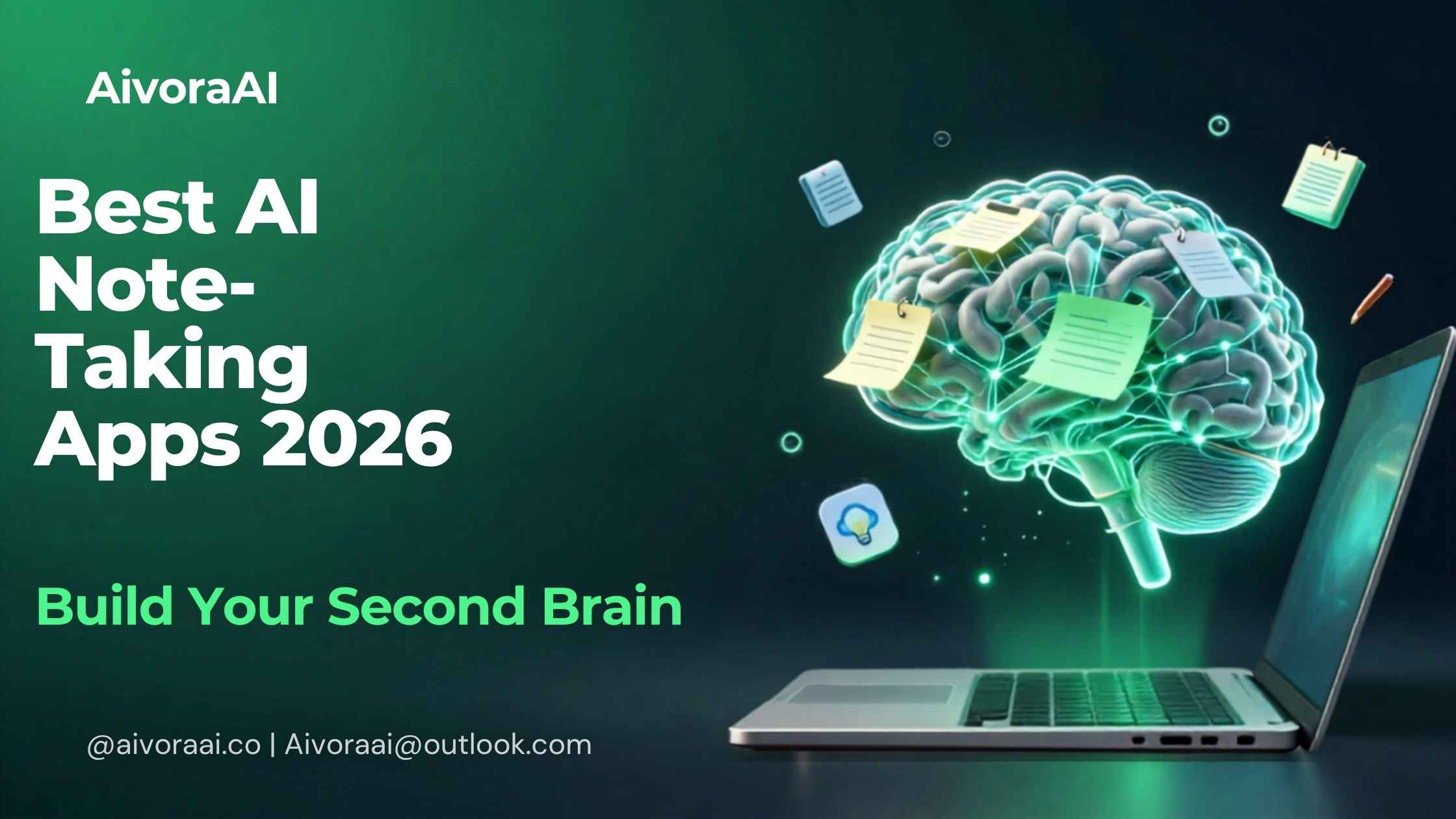
In 2026, the best apps are active partners. They use artificial intelligence to summarize, tag, link, and retrieve information. At Aivora AI, we believe your note-taking app should function as an extension of your brain—a "second brain" that never forgets. This guide analyzes the landscape to find the tools that truly help you work smarter.
If you're looking to monetize your knowledge, check out our guide on AI affiliate marketing to see how organized notes can fuel your content strategy.
Why AI Note-Taking Apps Matter in 2026
Information overload is the enemy of productivity. The average professional spends hours searching for documents they know they have but cannot find. AI apps solve this through three core mechanisms:
- Contextual Search: Finding notes by meaning rather than exact keywords.
- Automated Summarization: Turning hour-long meetings into actionable bullet points.
- Smart Connections: Suggesting links between new notes and existing archives.
Without AI, you are just a librarian. With AI, you become an architect of information. This distinction is crucial for scaling your output without burning out.
🔄 The Knowledge Flywheel
Capture
AI Process
Connect
Create
Turn raw information into actionable insights automatically.
Top AI Note-Taking Apps 2026
We tested dozens of apps based on four criteria: Intelligence (AI capabilities), Usability, Speed, and Privacy. Here are the standouts optimized for 2026 workflows.
1. Notion AI
Best For: All-in-one workspaces, teams, and project management.
Notion has evolved from a simple database tool into a comprehensive operating system for work. Its AI integration is seamless, allowing you to summarize pages, expand on bullet points, and even translate content instantly. It is the leader for productivity due to its versatility.
- Key Features: In-content generation, summarization, translation, tone adjustment.
- Price: $10/month per user for AI add-on.
- Pros: Incredible versatility, massive template ecosystem.
- Cons: Can be slow with large databases, steeper learning curve.
2. Mem AI
Best For: Personal knowledge management and automatic organization.
Mem is built specifically for the AI era. It does not just store notes; it connects them. Its core feature is "Self-organizing," where it automatically links related notes as you type. It feels like having a personal assistant who files your work while you do it.
- Key Features: Auto-linking, "Chat with Mem", self-organizing workspace.
- Price: Freemium / $8/month.
- Pros: Best-in-class automatic linking, fast interface.
- Cons: Newer ecosystem, limited customization.
3. Obsidian + Copilot
Best For: Power users, privacy advocates, and researchers.
Obsidian is a markdown-based app that stores files locally on your device. When combined with AI plugins like Copilot, it becomes a powerhouse. It is ideal for those who want total control over their data and love the concept of a "Zettelkasten" or slip-box of linked notes.
- Key Features: Local LLM support, graph view, complete data ownership.
- Price: Free app, paid sync/plugins.
- Pros: Total privacy, highly customizable.
- Cons: High setup friction, requires technical know-how.
Detailed Comparison
Notion AI
Best for Teams
Mem AI
Best for Speed
Obsidian
Best for Privacy
Best AI Note-Taking Apps for Students
Students have unique needs: recording lectures, organizing research, and preparing for exams.
- Notion AI: Great for organizing semester plans and research papers. The AI can help summarize long academic papers or format citations.
- Mem: Excellent for connecting lecture notes across different subjects, helping students see the bigger picture of their degree.
- Audio-Note Tools: While not mentioned above, apps like Otter.ai integrate well with these tools to transcribe lectures, which you can then summarize using Notion or Mem.
If you're interested in turning your study notes into income, consider creating an AI art course or educational content using your organized research.
Best AI Note-Taking Apps for Professionals
Professionals need speed and integration. They do not have time to tag notes manually.
- Microsoft Copilot (Loop/OneNote): If you work in a corporate environment, this is the default. It summarizes Teams meetings and populates action items in OneNote automatically.
- Notion AI: The standard for startups and agencies. It manages clients, wikis, and docs in one place, with AI helping to keep the documentation up to date.
- Tana / Reflect: Newer entrants specifically targeting the "thinking professional" market, offering faster workflows for daily journaling and idea refinement.
To maximize your professional efficiency, check out our AI Profit Masterclass review for advanced strategies.
Real-World Use Cases
Content Creation
A writer uses Notion AI to brainstorm blog posts. They dump raw ideas, and the AI organizes them into a structured outline with headers and bullet points, ready for expansion.
Project Management
A product manager uses Mem to track feature requests. As they paste emails from customers into Mem, the app automatically links them to existing feature notes, revealing which feature is most requested by high-value clients.
Research & Development
A researcher uses Obsidian. They load hundreds of PDFs and use the AI to scan them for specific data points, creating a web of citations that ensures they never lose the source of a finding.
Productivity Benefits
The quantitative benefits of using AI note-taking are clear. Users report saving an average of 5 hours per week on administrative tasks. More importantly, they report a decrease in cognitive load—the mental effort required to remember where information is. When you trust your system, your brain is free to do what it does best: generate new ideas.
For more tips on optimizing your workflow, read our guide on making money with AI tools from anywhere.
Expert Recommendations
My advice is to start small. Do not try to migrate your entire digital life into a new app on day one. Pick one project—like "Meeting Notes" or "Article Ideas"—and use the new app exclusively for that.
If you value simplicity and automation, go with Mem. If you need a blank canvas that can be anything, go with Notion. If you are paranoid about privacy and love tinkering, go with Obsidian.
And if you're just starting your AI journey, don't miss our comprehensive guide on how to make money using AI tools in 2026.
Frequently Asked Questions
Notion AI is the best all-rounder for teams and projects, while Mem AI excels at personal automatic knowledge management and Obsidian is perfect for power users who want total data control.
Most reputable apps use enterprise-grade encryption. However, you should review the privacy policy regarding AI training. Apps like Obsidian keep data local, which is safer, while cloud apps like Notion process data on their servers.
Yes, apps like Mem AI and Notion AI can automatically tag, link, and summarize your notes using machine learning to understand the context of your entries.
Related Guides to Boost Your Productivity
🚀 Start Building Your Second Brain Today
Stop forgetting and start creating. Explore our curated collection of AI tools designed to help you build a hands-free productivity system in 2026.
🤖 Explore AI Automation Tools →✓ Workflows · ✓ Funnels · ✓ AI Prompts
Written by Varun Lalwani
Varun is the founder of Aivora AI and an automation strategist. He builds and tests AI income systems, helping others escape the time-for-money trap. Read more about Varun